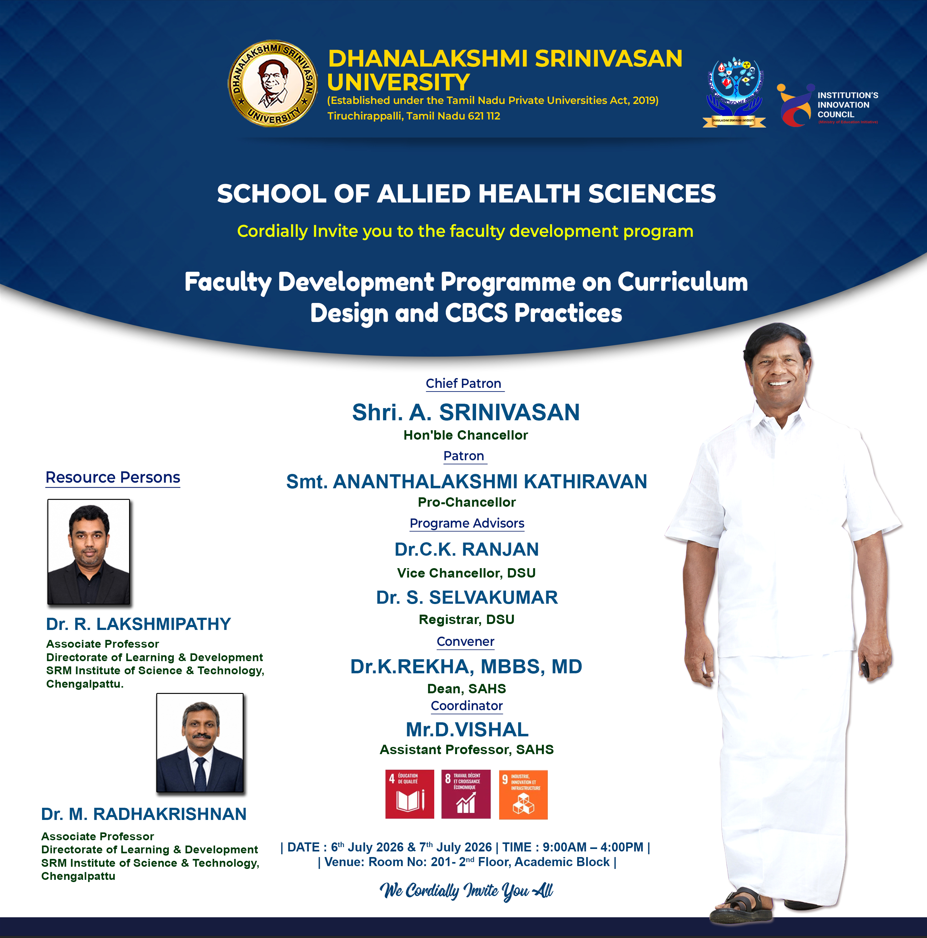
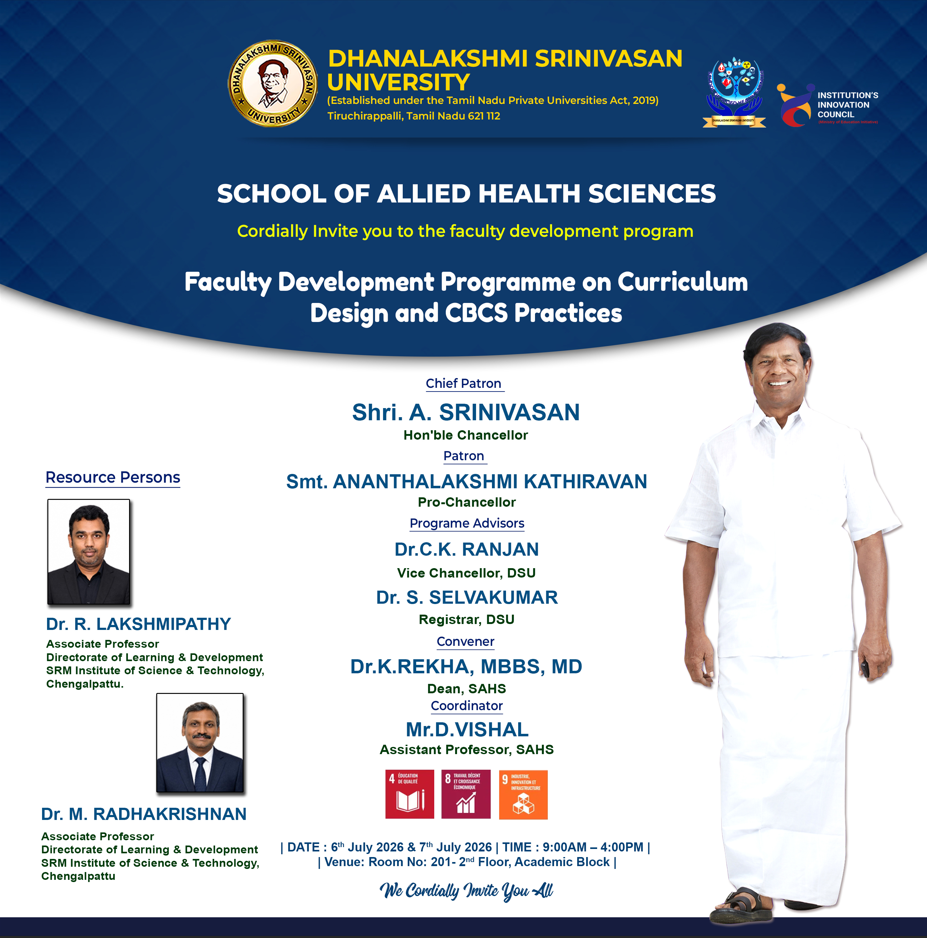
Faculty Development Programme on Curriculum Design and CBCS Practices
About the Programme
The School of Allied Health Sciences, Dhanalakshmi Srinivasan University, organized a two-day Faculty Development Programme (FDP) on "Curriculum Design and CBCS Practices" on 6th and 7th July 2026. The programme was designed to strengthen faculty competencies in curriculum design in alignment with the National Education Policy (NEP) 2020, detailed framework of the Choice Based Credit System (CBCS), and outcome-based education (OBE) frameworks. Sessions covered the design of competency-based curricula, formulation of programme and course outcomes, constructive alignment of outcomes with teaching strategies and assessment, curriculum mapping, and the integration of ICT-enabled tools for teaching and learning in Allied Health Sciences education.
Objectives
- To familiarize faculty with the provisions of NEP 2020 and their implications for curriculum design within the framework of the Choice Based Credit System (CBCS).
- To build faculty competency in designing competency-based and outcome-oriented curricula structured around core, elective, and skill-based credit courses under CBCS.
- To train faculty in writing effective, measurable Programme Outcomes (POs) and Course Outcomes (COs) for credit-based courses, ensuring each outcome is mapped to its corresponding credit weightage.
- To develop an understanding of constructive alignment among learning outcomes, teaching-learning strategies, and assessment methods across credit hours (L-T-P pattern) as prescribed under CBCS.
- To enable faculty to undertake curriculum mapping and competency integration across core and elective baskets, ensuring smooth credit accumulation and credit transfer pathways for students.
- To introduce ICT-enabled tools and digital pedagogies, including MOOCs/SWAYAM/NPTEL-based blended learning, to support credit-based, flexible, and student-centric learning under CBCS.
Expected Programme Outcomes
On successful completion of the FDP, participants were able to:
- Interpret NEP 2020 guidelines and apply them to curriculum design within the Choice Based Credit System for Allied Health Sciences programmes.
- Design competency-based and outcome-oriented curricula organized into core, elective, and skill-enhancement credit courses, aligned with national regulatory frameworks (NCAHP).
- Draft well-structured Programme Outcomes and Course Outcomes for each credit course, ensuring measurable linkage between course content, credit hours, and learning outcomes.
- Apply the principle of constructive alignment when designing teaching strategies and assessment tools proportionate to assigned credits (L-T-P).
- Carry out curriculum mapping exercises, integrate competencies across the core-elective credit structure, and facilitate credit accumulation and transfer in line with CBCS norms.
- Identify and apply suitable ICT tools and blended/MOOC-based learning options to strengthen choice-based, flexible, credit-driven learning pathways for Allied Health students.